Unity; The Path to Zion

Unity is a beautiful thing.  Harmony, synchonization, choreophraphed movement and sound….unity is what we all strive for.  The best and most heart rending compositions have times of great dissonance followed by a glorious resolution.  This interplay of division and unity makes music interesting.

Life has moments of unity.  Family, friends, hugs, and shared experiences.  Then life can be full of conflict, anger, disagreement, and frustration.  These moments can set us up for a glorious resolution. But how is a resolution possible?  In our families, our wards, our nation? How can we find a path to Zion, that heavenly land where we live with one heart and one mind?

My area of expertise, if I have one, is my boys.  They fight constantly. Last night we walked our dog Pepper to a friend’s house.  This friend adopted one of Pepper’s litter mates. As soon as we came to the door, Pepper found her brother’s scent!  The siblings greeted and then immediately launched into a lively play fight, which lasted probably ten minutes. They were jumping, rolling, yipping, and biting, growling at times, tails wagging, each wanting to dominate the other.  As I watched them I thought of how my boys fight. Sometimes its play, sometimes it’s bullying, sometimes it’s showing love. Sometimes I have to intervene, but a lot of times I just watch and listen and encourage them to talk to each other.  Sharing feelings is easy to do when you practice it. When my boys talk after a play fight has gone wrong, what I usually find is that there is no trust. “Layne took my toy and he won’t give it back!” says an angry Welsey. “Did you ask him to give it back?” I respond. “No, I know he won’t give it back. He’s mean!” Wesley doesn’t trust Layne. When I address those trust issues with them, teach them how to build trust with one another, and praise efforts to earn trust and be willing to trust, I’m teaching them important conflict resolution skills.

The fundamental reason our country is divided is trust. Why don’t conservatives trust liberal lawmakers not to take their guns?  They don’t trust them. Why do liberals not trust conservative lawmakers to deal appropriately with the difficult situations women are in when they have an unwanted pregnancy?  They don’t trust them. Trust is hard to earn and easy to lose. Both major parties have lost the trust of their opposition. You can be opponents and still have trust. Two soccer teams can play a game and there is trust that rules will be followed and the rights of everyone will be respected. Those games are fun for everyone. We learn to be better players and better people when we build, earn, and have the courage to trust others.

How can I build trust?  As I have opened up about my own story and my challenges, I have found others have shared theirs with me also.  I had no idea how many incredibly strong and resilient people I know! I know two women who lived through experiences so much worse than I ever had, and have dealt with them and come out as wonderful mothers that serve in the church and bless other’s lives.  They manage their symptoms and have good ideas for me to help with mine. I have a profound respect for them as the heroines of their stories.

As I have opened up about my story on my blog and shared my experiences, I have seen a different response in some others.  Its awkward. I find myself wanting to hide from them. I don’t know what they think of me. I’ve shown them my deepest parts of myself.  What if they think I’m a bad person? I chatted with a friend last night and she had some awesome advice. She said, just tell people that they don’t have to agree with you.  I first thought, “of course they know that, right?” After thinking it over, I thought. No they don’t! They don’t know why the heck I’m writing all this stuff. They don’t trust me that I’m not going to talk to them for a few minutes at church, and then turn around and write some blistering blog post about them.  

It is to this group that I am writing this post.  You can disagree with me! You can see things differently.  You can have any feelings you experience when reading my blog and I won’t judge you for it.  I do have a few rules I would like you to consider.

1-Own your choice to read the blog.  I don’t have a lot of warm fuzzy stuff on my blog.  It’s uncomfortable. If you can’t handle the raw, I get it.  We can still be friends if you don’t read my blog.

2-Respect my right to my experiences and my choice to share them.  This is an important tool in my recovery and it’s not up for discussion.  

3-Own your feelings.  If you read something that makes you angry.  Think about it. Why are you angry? Anger comes when you feel someone has crossed your boundaries, accused you unfairly, or put you down.  If I make you angry with my words, I welcome questions. I promise you, I have no intention to hurt anyone with my words, so maybe there is a miscommunication.  Ask me a question.

Example:  “Bridgette, when you compared members of the church to the pharisees, I was angry.  I see loving leaders in my ward that volunteer their time and talents to help others.  I’m a leader in my ward and I feel weighed down by responsibility and people complaining all the time.  I wish there was more gratitude and less criticism. I think criticising our leaders just leads to discouragement and bitterness.  Why do you think it is helpful?”

I love this comment because she owns her feelings.  She disagrees with my decision to share uncomfortable experiences I have in church.  When I liken our faults as faithful saints to those of the Pharisees, she sees it as insulting.  That’s understandable. No one wants to be like a Pharisee. I totally understand where she is coming from and why she feels angry.  I appreciate her courage to ask me about my motivations. If she hadn’t posted, she might carry this resentment toward me into our face to face interactions.  Because she did, we can resolve them. Also, others who read the post and feel similarly, will have their questions answered as well. This might be my response.

“Thanks for your comment and taking the time to read my post.  First, thank you for your service in your ward! Every calling is a burden to carry.  It isn’t easy to serve imperfect people, especially when they are prone to complaining.  I totally agree that expressions of gratitude to our leaders are important. I’ll consider doing a blog post on that very thing in the next week or so.  In writing about church members and pharisees, I’m not trying to discourage or insult anyone, just to invite introspection, both in myself and in my readers.  When I walk out of a meeting and see an unfamiliar face, how does that person see me? Do I look inviting? Do I see them as my Lord would see them? Am I a saint, or am I going through the ritualistic motions like a Pharisee would?  I’m likening the scriptures to my life to help me be a better Latter-Day Saint and sharing those thoughts in an effort to inspire others to do the same. I definitely don’t want to encourage bitterness or fault finding. Thanks again for taking them time to read and respond!  Hope to hear from you again.”

As I’ve pondered and prayed this week for my ward family, I know that others have been doing the same.  Miracles can happen. Hearts can soften. The Savior wants us to come together and approach him in humility.  Right now, I don’t have a lot of trust in my church leadership. I feel they don’t understand me and the unique challenges I face with my mental health and the incredibly difficult journey I have taken in my recovery this year.  Mental health stigma is real. It is ingrained in our culture and extremely difficult to overcome. Our leaders don’t have the training to get a complete picture of what my needs are. Some are hostile to mental health and think they know better than my therapist how to solve my problems.  They are in a difficult position, but so am I. We need a lot of humility and grace to navigate this situation. Humility is not staying silent and avoiding conflict. Humility is not allowing yourself to be mistreated. Humility is submitting your will to the will of the Savior and then acting on his promptings.  

This week has been an uncomfortable week of dissonance.  I hope that it will be followed by a glorious resolution.  My ward has the power to change our town. There are so many strong and amazing people in this ward!  There is so much good. I know several of our sisters have been praying in the temple this week. There’s no doubt in my mind that they put my name on the prayer roll even if they think I hate them.  (I don’t) To them I say, thank you. The good that you do matters to me. I love you and it’s okay for you to feel however you feel about me and my words. We are all imperfect people, and I am not your judge.  I’m your sister, and I hope I can earn your trust and we can come together at the feet of Him who is Mighty to Save, to heal, to unite, and to bless. I know he will lead us to Zion!


Fruit of the Tree

I wrote this post a month ago. I’m just getting to where feel comfortable publishing it.

When I started having anxiety and depressive symptoms, I had no idea why.  I thought I was perfectly fine.  There was something wrong with my lungs, there was something wrong with my heart, there was something wrong with me physically.  It couldn’t be in my mind.  I was a Molly-Mormon, perfect girl raised in a perfect Mormon family.  Why would anything be wrong with my mind?

I didn’t know then what I know now on a deeper level.  There are two parts to my mind.  One part is divine, a spirit, came from God and destined to return to him.  The other part is fallen man, living with other fallen men, in a fallen society.  Within that society there is a social construct.  It is important to differentiate what that social construct is as opposed to God’s law.  They are two very different things, although they do overlap in some ways. 

Social construct is all too familiar to a young mom like me.  You wear shoes to the grocery store.  You don’t park in the handicapped parking spots.  You drive on the right side of the road.  When you go to church you dress nicely and sit quietly.  These are social constructs.  They are the ways that man has devised to live together and avoid conflict.  Children are notorious for disregarding social constructs because they don’t know them.  They run out into the road, they scream in sacrament meeting, they tell the bank teller she’s fat.  And yet, the scriptures are very clear that they cannot sin.  They are incapable of sin.  What does that say about social construct and sin?  They are two different things.  They may seem the same, but they are not.  Ignoring or breaking the social construct and the rules of nicety that we have set up may be sin or it may not be.  God’s law is not based in behavior. What is God’s law?  God’s law is very simple.  We are to love God and love one another.  The Savior says that upon these two hang all the laws and the prophets.  The thing is, love cannot be seen.  It exists within the mind and heart.  Love doesn’t manifest itself in what we wear, how quietly we sit in sacrament meeting, or how careful we are to obey traffic rules.  Love is difficult to measure and more difficult to define.  In the Book of Mormon the Love of God is symbolized by a tree that has fruit which is white and delicious.  The followers of Christ are drawn toward the tree, a symbol of Jesus Christ.  The Savior has said, “Greater love hath no man than this, that he lay down his life for his friends.”  Jesus Christ himself was the Love of God made flesh.  He came to show us what love looks like.  To learn more about this parable in the Book of Mormon, click here.

I love this image. In the Book of Mormon, an entire parable is given centered around a tree that symbolizes Jesus Christ. When we eat of the fruit of this tree, we make a spiritual connection with God through his Son. This connection makes us happy and whole.

I mentioned, in one of my less controversial comments in Relief Society on Mother’s Day, that I am always amazed at how quickly my children are able to find the Savior in every picture.  The spirits of the children of God know their shepherd.  They know Jesus Christ, and they are naturally drawn to him.  As we learn of him through the scriptures, our spirits help us to make sense of this world and how He would have us live in it regardless of social construct.  He teaches us how to love.

In the meantime, the schools, our families, the legal system….they teach us how to be fallen humans.  They teach us to survive, to lie, to hide, to fear.  Most of all, we are taught to follow the rules.  You have to figure out who the biggest baddest person in the room is, and make sure you make them happy.  Who has the biggest gun?  Don’t get in their way.  Game the system, take what you need, look like you fit in.  If it’s in a gang or in a church, dress the right way, talk the right way.  Learn the rules and follow them.

As I have worked through my recovery, I have found myself in conflict with my social construct.  The way a Mormon woman is supposed to look, feel, and act.  I’ve found that the woman I was created to be is different than the one I’ve been trying to be all my life.  Maybe that’s why I have empathized so strongly with my bisexual friend.  Our journeys have not been so different.  She has found that in her recovery, she is no longer the person she needs to be, or at least appear to be, to fit in.  In being true to her own core self, she can no longer be what others want her to be.

As I gain strength, the need to fit into my social construct fades.  I quiet my fears, question my lies, come out of the shadows of my hiding place, and relax my grip on the need to survive.  I see myself as a lily in the field, created by God for his purposes, provided for by his divine plan with sun, wind, and rain.  The social construct that was my prison, is now behind me.  Like a chick leaves her egg, I leave the fallen construct behind, and search for my Master.

Come learn of me, and listen to my words.  Walk in the meekness of my light and I shall give you peace.  For I am Jesus Christ.  Take my yoke upon you and learn of me; for my yoke is easy, and my burden is light.  He doesn’t care what I wear or how beautiful I am.  Whether I am rich or poor is unimportant.  He wants nothing from me.  He only gives.  Love.  Once you have it; once you’ve eaten the fruit of that tree, you know what to do.  You give that Love to others.  You call to everyone you can see to come and eat the fruit.  It doesn’t matter if they are in the depths of the river or headed to the building, everyone needs to have it.  Love.  Unconditional.  No social construct.  No guns.  No biggest, baddest guy to fear.

A society of love is heaven!  If each person is eating from the tree and passing that love around, there is peace and happiness.  Our differences are not important.  Our sins are swallowed up.  Our natures are changed.  We have become a new people.  His people.  We have no need for the cage of social construct because we are naturally looking after the needs of one another.  It isn’t forced.  It comes from a changed nature.  A reborn person.  No longer fallen, but saved.

There are a lot of lies that Satan tells us, but the one I have the most difficult time with is the lie that social construct IS God’s law.  That if I please everyone around me, I have pleased him.  If I upset those around me, I’ve upset him.  The scriptures are full of examples that teach us that this isn’t the case.  Many of the prophets of the Old Testament were murdered because they upset the social construct.  They pleased God and enraged those around them who propped up and profited from a fallen system.  Jesus Christ, the Word and Love of God made flesh was the most offensive of all to the social construct of his day.  They not only murdered him, they tortured and humiliated him.  Still, even two-thousand years later, he continues to lift and inspire those who own him Lord.  They can’t kill what lives inside our hearts.  We’ve tasted the fruit!  It doesn’t matter who is upset by our determination to love and share Him. 

I don’t have a lot of followers on this blog.  I make no money.  This blog exists for a single purpose.  To bring me away from my social construct to Christ.  The reason it must be public is that courage is required to complete this process.  I don’t completely understand it myself, but I have to do this in the open.  Maybe it’s because every time I tap “publish” I am letting go of that need to write something people will like.  No one is required to witness this.  No one has to agree with it.  It is personal, it is sacred, it is my story.  My journey to Jesus Christ.  It’s real and raw and for many, including me, incredibly painful; but I know that in the end, He is the only one who will heal my depression.  Because of this, my blog is a vital part of my recovery journey.  I feel the mocking eyes of those in the building, but my eyes are not on them.  I’m at the tree.  I am ever his humble handmaid.  On my face.  At his feet.

Being a Saint

I talked to my bishop yesterday about some of this stuff. The whole ward is kind of upset by everything that happened Sunday, and that’s understandable. A ward is like a big family, it can be pretty dysfunctional at times. He said something that has stuck in my mind. I don’t remember exactly what he said but it was something like, “We are all really imperfect people, and we all make mistakes and hurt each other, but we can work it out. That’s what makes us saints.”

So this post is my good faith attempt to clarify my experience on Sunday and be a saint. I want to work things out with my ward family.

My experience on Sunday is mine. It is what is sometimes called, “My truth,” which includes my intentions, my feelings, my perceptions, etc. It is not the whole truth, which only God sees. Each of us sees a situation from our own perspective and that means everyone has a different view of what actually took place. I respect the right of others to have a different view.

I walked into Relief Society and took a seat on the back row. The lesson was disturbing to me on many levels. As I considered the way the discussion was handled and the attitude toward things like science which seemed to me was lumped in with the philosophies of men. It seemed that the Family Proclamation was being held up as the ultimate source of truth and that any evidence challenging anything in the proclamation from whatever source should be considered suspect. The whole discussion made me feel frustrated and brought up a lot of the same confusions I’ve felt in the past. I decided to disengage. I thought of getting out a notebook and writing. Then I had a thought about my friend and my experience with her. I thought, “That is just what this discussion needs. A personal experience that can really get to the heart of this.” Then I hesitated. It would be like throwing a hand grenade into the room. The teacher was clearly hostile to any ideas that would contradict the narrative she was pushing, which I gathered was, “The prophets have all the answers. They are in the Proclamation. Anything else is from Satan.” Then I had a clear feeling. A prompt. “You need to say this. There are people in this room that need to hear it.” So I raised my hand.

My eyes met with hers for a moment, and I could tell that she was ready to be done. There were two other hands up. I said a quick prayer in my heart that if he really wanted me to give this message, that she would call on me and that her heart would be softened to accept what I had to say. As the moments ticked by and she called on every possible person in the room, she said, “Yes, Bridgette. Make it quick, we are out of time.” I was flustered. How could I make it quick? My mind raced through the incredibly painful and life changing experience I had helping my friend through her struggles with these issues. Seeing the pain in her face as she told me she had missed choir because she had been in inpatient psychiatric treatment, of the depth of her testimony and the heart-rending truth that life in the church was going to be difficult if not impossible for her. My voice faltered a bit at first, but then the prompt came again. “You say this, and you make sure this message is heard.” I tried to be quick. I had only told the bare facts of the story in a rush, and I heard her say, “Okay, we’re done.” I stopped, stunned. I had hardly said anything. I spoke up again, a pleading in my voice. “I just would really like to finish my thought. I just wanted to say that-,” and then she interrupted me and started talking again. Louder. I felt driven to speak. I had to say what I said next. I said, firmly, “We don’t know everything. That’s okay. All I know for sure is that Jesus loves her,” my voice cracked as I thought of how much love He has for my friend, and for me, and for each precious soul that faces these issues and suffers misunderstood. “He has a path for her. That’s all I have to say.” And then I started crying. And crying. I said softly, “This is why I don’t come to Relief Society. I’m never coming back.”

There were a couple of comments after I spoke. I didn’t hear them. I heard the children in the halls. Primary was over. All I wanted to do was get out of that room. People were coming up to me. They were comforting me. Some were angry at how I had been treated. Some were touched by the story of my friend. I was surprised at how much it resonated with them. I had hardly told the story well. Maybe the spirit had told them what I could not. I wiped my tears, gave hugs, and listened to heartfelt comments of support. Then, I made a beeline for the first exit I could find that I could get to my car. I saw another couple of sisters. I gave them hugs and we talked for a minute. Then she walked up. Our eyes met again. She gave me a hug. I wanted to think that she was sorry for how she had treated me. I nodded along as she made her excuses of time and children. I wanted to believe them. But I didn’t.

It wasn’t the time that was the problem. I sense that either it was me, or my message that primarily caused her reaction. I took comfort in the realization that although I wasn’t able to share my friend’s story well in Relief Society, I could share it on my blog. Also, I could explore some of my feelings about grace and the tendency of church members to gravitate toward works. When I got home, it felt so good to explore on my blog, what I didn’t feel able to do in that class. The way I felt trapped and confused in Relief Society gave way to feelings of peace and acceptance for what happened to me and my friend.

I was humiliated. I was shouted down. I was treated badly by someone called to serve and love me. That’s part of this life. It hurts. But in this world, that’s what happens. I’m just the broken handmaid of the Lord. Look what they did to Him! He was a lot more perfect than I am. It’s not really that surprising, even if it is profoundly disappointing.

This whole thing has been a roller coaster of emotions. I put this post out there to lay to rest any confusion about my comment in Relief Society being somehow motivated by a desire to sabotage the lesson or purposefully make anyone look bad. Anyone who knows me knows that that isn’t me.

This morning I’ve been thinking about how much division this has revealed in our ward family. I don’t think that my comment or even the horrible way it was handled is the root of the problems we face. The good news is, I don’t have to fix those problems.

This morning as I snuggled with Austin, I thought, it doesn’t matter what anyone thinks of me. It doesn’t matter if they gaslight me and blame me for what happened. I have my husband and my children and my Jesus. Worst case scenerio, I can take a break from church for a while. Maybe I could even get permission to change wards. I could go to a ward in North Arlington. A ward outside of the affluent suburbs, well manicured lawns, and privileged lives. Somewhere where people are hurting and can empathize with a tortured soul like me. I could sing in their sacrament meetings, and bare my testimony for them. Maybe I could find acceptance and love instead of shame.

All I know is that I will never stop blogging. I will never stop speaking when I feel there is something I need to say. I just need to find a place where I can speak safely.

As I make these difficult decisions, I ask for some space. I’m not going to be on Facebook for a while. I probably won’t be posting on my blog or responding to comments. My son has been neglected for several days as I’ve written and cried, and laughed and celebrated. He doesn’t deserve that. He needs his mom, and I need a break from all the drama.

Please pray for me. Pray for my ward family. I’ll be praying too. Miracles can happen. Hearts can change. The Savior has a design. Sometimes there are Gethsemanes before there is a resurrection.

Celebrating Recovery

The last few days have been full of ups and downs. I got to talk to my counselor tonight about all of them. She was amazed at how strong I was; how smart, how cool headed, and how compassionate I was through all the hurt and all the pain. I told her thank you, and she said, “You are doing all the hard work here.” She’s right. I’ve been changing myself. Its hard to change, but it’s so worth the effort.

Finding my voice online has been so empowering. Surrounding myself with supportive friends has helped me do things I never thought I could do. Strangely, taking on my online persona of the Handmaid of the Lord has helped me be more like him. Whether saying something uncomfortable in church that makes people think, or standing up for someone who needs support, that is what the Savior did. I can do it too.

Each person, no matter where they are can change the world around them. It just takes a little courage, and a lot of therapy! A blog also helps…..

I’m so thankful to everyone who has shown me love through my suffering right now. Each one of you has helped me more than you know. My heartfelt prayers tonight will praise you. You are my angels.

To those who don’t understand. That’s okay. We can figure it out. We are all on the same team. Satan is the enemy, not our brothers and sisters. We are here to help one another.

Mostly, praise be to the Master! He is the designer of my recovery; the sculptor of my future self. May I ever be his instrument to lift and inspire. Love to all, malice to none.

Dear Heather, I hope you read this…

After my last post, a woman named Heather posted a comment on my post “Giving Grace; Have a Tutu.” She said this:


You chose the wrong place to spout your “beliefs” you should talk to your Bishop. Poorly done.

Heather

This woman’s comment is classic Mormon woman aggression. Mormon women can and do shut each other down, shame each other, and make life hell for people like me who struggle with mental health issues. Heather is unusual because she is so direct. Usually we are much more subtle in our aggressions, usually couching them in many “concerns” and assurances of our “love.” Heather was able to capture in a mere two sentences, the essence of Mormon woman aggression and the problems it poses. At first I dismissed her comment as a troll remark, but now I see it as a gift. I’ve sent this post to her email in hopes that she will read it and perhaps she can learn from her post as well.

I’m going to start by looking at the first thing she takes issue with, my temerity to actually put my thoughts and feelings on a blog. According to Heather, that is my first mistake. I’ve heard this sentiment from others. They are basically uncomfortable with feelings being shown at all. In their minds, if feelings are to be shared, it should be with a trusted friend or group of friends, not the whole world on a public blog. It isn’t something they would feel comfortable doing, and they aren’t comfortable with me doing it either. The big question is……why?

We all have thoughts. We all have feelings? Did God make us to experience life in a personal vacuum, grappling with issues alone and without the tools to solve them? I don’t think so. You are free to disagree of course, but why are you so upset that I choose to post? It is me that is taking the risk, not you. You are free to ignore my posts and go play Candy Crush. Why does my choice to speak bother you? Maybe its because you are afraid of the truths I might reveal to you that might challenge some of your own beliefs? But if your faith is so strong, why is it so threatened?

The next thing to analyse is the word belief, which she puts in quotations. The assumption is that my thoughts are unworthy of the word beliefs, which would indicate something good and wholesome. My thoughts are nothing of that sort to Heather, so she chose to put the word in quotations.

She admonishes me to talk to my bishop, which title she capitalizes. This shows that she values church authority, is clearly a member of the Church of Jesus Christ of Latter-Day Saints, probably card carrying. She neglects to mention what sin I should confess, assuming that I must already know. My words are the devil’s spawn. She has no empathy or compassion for me or my bisexual friend. She knows little to nothing about me, and yet feels totally comfortable discounting my views and shaming me.

Lastly, she posts two words, “Poorly done.” This is interesting. It is like Heather has decided to be a fifth grade writing teacher judging my writing to be sub-par. It isn’t just my ideas, but the presentation of them that offends her. Everyone is entitled to their opinion, of course, but even a fifth grade writing teacher would surely have something more constructive to say. Heather can’t be troubled with constructive criticism.

All of my views came from Facebook referrals, so I have to assume that Heather is either a Facebook contact or the contact of the two friends who shared my post. Regardless, it isn’t Heather’s feelings that I take issue with. It is her failure to own her feelings.

In my blog post, I engaged with vulnerability. I shared personal information about myself and my experience in Relief Society, with my bisexual friend, with my own changing views of gender and sexuality in light of the experiences I’ve had. Heather is uncomfortable with my experiences. Guess what? I am too! This hasn’t been a fun easy path for me. I wish I had all the answers! I wish simple and easy solutions worked. This life is messy and complicated and confusing. Can we be real about that? Because for every five or so members of our church sitting in a Sunday School class with a Family Proclamation handout in their lap, there is one thinking, “My son told me he is gay. He will never be accepted by these people. No one can ever know.” Or maybe its, “My sister told me she wants to get a sex change. She wants me to think of her as my brother now. I wish I could tell my ward family and have them understand how hard this is. Instead I’ll just nod along and pretend this isn’t hard for me.” Can we listen to what they have to say? Can we resist the urge to judge? Can we choose to show love first? Some can’t do that. In fact, they are so afraid and so insecure in their faith, that they feel compelled to lash out. They pour acid into the wound. This makes church an excruciating experience for those who most need to feel the love of the Savior.

The truth is, Heather’s comment has nothing to do with me. It has everything to do with her. She feels uncomfortable, and she wants to blame someone. Its me. I must be evil. I must be apostate. I need to repent. I need to learn to write better. She read my post and now she feels bad inside. It must be my fault.

The only thing is, I didn’t do anything wrong. I even prayed and begged the Lord, “Show me my sin.” And He said, “You said what I wanted you to say. Be at peace.” Even after his assurances, and the assurances of friends, I still felt tortured with grief last night. Ripple effects from what happened Sunday have continued to cause conflict in the ward. I laid awake sobbing, struggling with suicidal thoughts after a day of being nearly incapacitated with depressive symptoms. This morning I’m angry. This is not my fault! I didn’t create this mess. Someone crapped in the Relief Society room. I didn’t do it and I’m not going to sit there and pretend it doesn’t stink. I’m going to express my feelings. I’m going to be real about my experiences. That’s what HE wants me to do.

So if I’m saying what he wants me to say, why do card carrying members of our church, like Heather, have such a visceral negative reaction to it? Because the truth is real and its uncomfortable, and sometimes it reveals things that are hard to deal with. But that is reality. Members of the church need to grapple with that reality and their feelings, not blame the messenger.

So my message to Heather, or any others who find themselves feeling like her, I encourage you to engage with your feelings. Explore them. Why is this so uncomfortable for you? I’m going to make a few assumptions. There is a lot of confusion, a lot of Satan’s lies, a lot of anger, a lot of societal upheaval around sexual issues. You feel that the Family Proclamation is an anchor in the storm. You take comfort in the unchanging principles that the prophets have revealed in a world of changing social moors. You feel that there is safety in following the prophet and that if people are righteous, they will be able to live as straight, happy, married people. That makes sense. If people can’t do that, they are the ones living in sin. They are to blame and deserve to be shunned and excluded.

So if that is the whole truth, why do my words cut you? You hear my sincerity. You know in your heart that shunning and excluding someone because of inner struggles with gender and sexual attraction is wrong. You know that the Savior you claim to worship would show empathy and love. You know it, but that makes it hard doesn’t it? How do you love and associate with someone when you disagree with their choices? How do you help a depressed sister when you can’t fix it? It’s hard. It’s okay to admit it. Own your feelings. Own your doubts. Don’t blame me because I showed you that life is complicated and hard.

The Savior said that he was the physician, and that the sick are the ones that need him. If the Savior is the physician, then that makes the church a kind of hospital. If the hospital is full of healthy people, that makes things really easy, right? No late nights, no stinky bandages, no gaping wounds, no testing to do, no vague symptoms to diagnose. The shifts are short with lots of time to chat and sit around.

Are our church congregations safe for the injured? Do they get the help and support they need? Are we like our Master, the great physician? How can we do better?

Except under those nursing scrubs there are festering injuries, debilitating diseases, torturous rashes-all of them treatable, if only people could just have the courage to tell someone they are there. If someone does have the tremendous courage to take off part of a bandage, what will the reaction be? Will the staff jump up to assist with competent treatments at hand? If not, you can guarantee there will be no more healing in that hospital. Not only can the staff not get healthy themselves, how are they going to help any patients who come through the door?

And yet that’s what I see too often in my fellow sisters. Under our well set hair, carefully planned lessons, and clean dresses, we have wounds. We have doubts. We have fears. We have struggles. We hide them and expect others to do the same. I’ve seen very positive trends lately of sisters in my ward who have had the courage to talk honestly about their personal struggles particularly with mental wellness. Unfortunately, I have seen a corresponding backlash against mental health treatments, sometimes even from the leaders. This backlash is against mainstream mental health treatments; not fringe scam treatments, but medically approved, insurance paid treatments like cognitive behavioral therapy. Some of these treatments are even at LDS Services! Really?

I try to be patient. I try to explain and resist being easily offended. I try to take it in the teeth when my hard earned knowledge is scoffed at, cut off, and dismissed as “the evil philosophies of men.” I’ve done it for twenty years. No more. Mormon women, stop the hate. Stop it. I have mental health problems. No you don’t understand them. That’s okay, but just STOP the stigmatizing!! Each time you do it, you make it harder for someone else to get the treatment they need. If you are in church leadership, take the time to listen. Don’t think you know more than the therapist that is treating your friend. You don’t. Listen. Learn. Take the time to really tap into what the LORD is telling you about what this person needs. Have the humility to know that you weren’t called because you know what people need. It is because HE does and he trusts you enough to do what HE wants.

I have had too many church leaders tell me things that totally contradict my therapy plan. Not just a little bit. Totally contradicting. As in, my therapist tells me to explore my relationship with my parents. My leaders tell me to be grateful and forget negative past experiences. My therapist tells me to stand up for myself and confront an abuser. My church leaders tell me to forgive and forget. I am having a mental health crisis and my Relief Society President criticizes how I handled the situation. Rather than take steps to solve the systemic problems with mental health stigma among the sisters, she tells me not to talk to my counselor. In each of these situations, my leaders did not take the time to hear everything. They assumed. They minimized. They said to put the bandages back on. I looked just fine to them.

Heather, if you are still reading, I know you and those like you will be saying, “Now she’s criticizing her leaders! This is apostasy!” No it isn’t, because these leaders are me and you. We are the body of Christ. If one hand reaches out to help the other, that isn’t apostasy. That’s healthy behavior. Your words hurt me. But I forgive you! I forgive every church leader who has sabotaged my recovery. But can we talk about what I’m forgiving? Can we figure out how to stop hurting people like me who are trying hard to stay alive, stay functioning, and be there for our kids? If that’s apostasy, please excommunicate me. I’ll go gladly. I think we can get through this.

I have faith in YOU Heather. That’s why I’m taking the time to write this. I wasn’t so different from you twenty years ago. I can see myself writing something like what you wrote on a blog like mine. I hope you don’t have to suffer for twenty years before you come to see that what you did was wrong. I have faith that we are better than this. I have faith that we CAN and we WILL meet the challenges we face in our congregations. So I will continue to write, continue to speak, continue to shine a light on these problems. I will not put the bandages back on. This is not okay.

I’m grateful for the voice I have. God gave me this voice. Its a gift and a privilege to be able to write something that people actually take the time to read. I pray that I will be able to use this voice responsibly. I’m angry and hurt, but I feel calm right now. Anger and pain can be powerful to motivate. They drive me to my keyboard. I pray that my words will help and heal and not wound.

God Mend Thine Every Flaw

I’ve been in the news and on Twitter obsessively for a couple of days now. The Mueller letter to Barr was published by the New York Times and the Washington Post and since then, I have been able to think about little else but the danger my country is in. Right now my hands are white from a Raynauds attack that I suspect is only partly due to the cooler weather today. I feel like some weird radio that picks up the frequency of disaster and then I have to write about it.

After reading numerous reports and watching many cable news programs, I have processed a few thoughts.

The ship of state has been sailing along for the past hundred years or so with few problems within. The Civil War was over, the only wars we fought in were far from our mainland. We had economic problems, and world wars, and the cold war, along with several world peace/stability proxy wars like Korea and Vietnam, but for the most part, we have been prosperous and safe. As we have charted our course through the calm waters, we have become more and more secular, more and more urban, more and more disconnected from the Earth, more and more dependent on one another and less dependent upon God. The result has been the rise of several modern trends.

First, the trend of environmentalism which is, at its heart, the instinctual reaction of people to the danger of mankind disconnected from the Earth. The Earth teaches us the law of the harvest, the law of increasing returns, the value of hard work, and so much more. As large percentages of our populations move to urban centers we loose the roots that bind us to the Earth and in a spiritual sense, to God. Environmentalism is one way moderns have tried to mitigate the damage of this disconnect. Unfortunately, in its more extreme forms, environmentalism becomes orthodoxy, or like a religion, with zealous advocates that insist upon widespread adoption of strict rules and regulations. The movement is largely political and social, and doesn’t recognize the profoundly spiritual needs that fuel the fervor. Because of this secular and social focus, the movement has alienated, ironically, those who are not urbanized city dwellers, but the rural communities who are not a part of urbanization and are therefore immune to the forces that created the movement. They don’t see the need for environmental concern because they are still connected to the soil.

Second, secularization of society as a result of increased diversity. When there is a great deal of religious diversity, the easy and lazy approach to getting along is secularism. We just don’t talk about our differences. We don’t pray in schools, we don’t put religious symbols in our courtrooms or city halls, we keep a wall of separation between church and state. The problem with this approach, as we are seeing, is that religion is the fertilizer in the orchard of public morality. Without the essential rituals and reminders of religion, as a society we drift ever further from the principles of morality which make society possible. The breakdown of norms in the executive branch is clear evidence that the moral fabric of the nation is unraveling. George Washington in his farewell address was right. Religion is an indispensable support to morality in a society. So secularism, while an easy solution to the dilemma of religious diversity, is unsustainable.

If we are to survive, we must become a religious society that is able to tolerate a large diversity of perspectives. This means eschewing divisive orthodoxy, stripping down of false doctrines, and forcing ourselves to see the world from the viewpoint of someone dramatically different. We must make room in our public spaces for all religious expression. We must form a new faith in which we take all the spiritual knowledge of all different faiths and put it in the marketplace of ideas. It is not so different from science. Scientists from all over the globe share ideas and insights and research. Why should it be different spiritually? It is time to cast out fear and orthodoxy and begin experimenting on the word. If we believe our religion to be of value, we should be willing to share it. If we know that we don’t comprehend the eternal nature of God and his complicated relationship with all his children, and anyone with a smidgen of humility should know that- then we should be willing to admit that we could benefit from the study of other faiths.

Third, the creation of the two party system. The two party system has evolved over time as the most efficient way to govern. The parties have created caucuses of factions which must compromise with the whole in order to gain seats and influence in the government. This has resulted in two moderate parties, a government with smooth transitions of power, and a remarkably stable system of norms and institutions that serve the public. There have been other benefits to the two party system. An extremely busy society of specialized individuals can simply choose a party and then be alleviated from the inconvenience of having to study each candidate and issue that comes up for a vote. The parties have come to be trusted by Americans who belong to them. At least as trusted as any group with power. We are a rebellious and suspicious people.

Unfortunately, over time the parties have polarized into two vastly different groups of people who, like the builders of babel, hardly speak the same language anymore. We are divided by race, religion, economic status, age, and even geography. In the information age, we have our own separate media to keep us informed. The parties have found that in our modern age of social media, and a large percentage of apathetic and poorly informed voters, that moderate language and compromising policy is politically unpopular. The rise of Donald Trump has shown that a combative style, a bombastic disregard for social norms, and a flippant exaggeration of facts can get you free publicity which can put you head and shoulders above more qualified candidates in a crowded primary contest.

Don’t think for a moment that opportunists of both parties are not taking note of this trend. Donald Trump, although exceptionally shrewd in some things, is remarkably sloppy. His misdeeds, as chronicled in the biographies I have read as well as the Mueller report, have been clumsy and lacking in sophistication. This inspires sympathy in his supporters, but in those with greater skill at deception and a thirst for power, it shines a spotlight on our vulnerabilities and gives them a roadmap for their own tyrannical plans. If Trump had been a little more careful, he may have succeeded in shutting down the Russia investigation and we would not know what we do now. The shrewd would-be tyrant will learn from his mistakes.

The parties increasingly have no interest in E Pluribus Unum. They don’t want to unite with the other other party to become one nation, all they need is a passionate and energized 15%. Then the other 35% of more moderate party members will go along to get along. The facts aren’t as important as the passion that gives a shared sense of identity and purpose. The party is your family, your tribe, your identity. I didn’t realize how important my identity as a conservative and a Republican was to me until I lost it. I feel as though I have been banished. I have no country living in a country where party is all that matters.

And so we have two parties that have two diametrically opposed narratives that are ironically the mirror image of one another. The first is the traditional one. This one is supported by the institutions of federal law enforcement, the traditional news media, and most Americans who have not completely lost faith in our system. This narrative is that a dark horse candidate, Donald Trump, rose above the primary contenders in 2015 to snatch a major party nomination in spite of having no qualifications or experience in public office. That hostile foreign players, primarily Russia, actively supported his candidacy and enabled its rise. That the Trump campaign had several suspicious contacts with Russian nationals that aroused the suspicion and concern of federal law enforcement which then opened a counter-intelligence investigation into the campaign. After Donald Trump was elected President and sworn into office, he believed that he could stop the investigation which he feared would be problematic for his Presidency. He took bold measures to stop the investigation including firing James Comey who showed an unwillingness to be sufficiently “loyal” to him. This resulted in the appointment of a special counsel. Trump continued to fight against the investigation both publicly and privately, resulting in many legal professionals concluding that he may be guilty of obstruction of justice. Trump appointed an attorney general who he believed would be loyal to him and he has shown that he is willing to lie to congress, withhold parts of the special counsels report from public view while giving favorable impressions about the findings of the investigation, and entertain the most bizarre conspiracy theories the President likes to tweet about.

The other narrative is that during the Obama administration, the justice department was corrupted, and that James Comey and other top FBI officials conspired to bring down the Trump candidacy. These individuals used a deceptive FISA warrant to “spy on” members of the Trump campaign. In spite of their efforts, Trump was elected (because he was the best candidate ever, and could outsmart and beat these nefarious players). Hillary Clinton and Barack Obama are apparently the masterminds behind this whole sordid conspiracy to undermine his Presidency. They are the leaders of the “deep state” which is catch-all phrase that defines anyone not gullible enough to see through this narrative. “This was an attempted coup!” Trump insists.

Apologies to anyone who might be offended by my comical take on this. This narrative doesn’t hold up to much scrutiny because it isn’t meant to convince anyone, it is meant to sow reasonable doubt. This is a big show trial, and all Mr. Trump needs to do is sow enough reasonable doubt for him to be acquitted by his large jury. He is betting that people will get cynical and say things like, “All the politicians get help from foreign nations,” or “They are just doing all this because they don’t like him,” or “If a Democrat had done this, it would be no big deal,” or “the mainstream media just hates all conservatives.” If he can get us to say these things, then he and Russia have succeeded in their misinformation campaign. Trump will get away with his crimes, and open the door to future corruption and norm breaking. Before long, we do have a corrupt justice department and a deep state conspiring to destroy the campaigns of their opponents, and succeeding. The very lies we were told become the reality we feared.

That leads me to the final societal trend, which is cynicism. The cynic believes he has no voice, no control, no impact on the world. He doesn’t seek to make society better, because he believes in nothing, least of all his own power or vision. He looks down on those who allow themselves to become emotionally involved in what he sees as beneath him. The scriptures refer to this modern person as one whose heart has turned hard. This individual is able to see the children sleeping under foil blankets at the border and shrug. This individual looks at the possibility of an impeachment of the President as a distraction from healthcare. This person believes that racial, religious, and economic differences are insurmountable, and its everyone for themselves. This person sees moral standards as impediments to power. This person looks at those who fight against incredible obstacles in foreign lands to secure the blessings of freedom that the cynic has enjoyed since birth, and they say, “We don’t need to help you. We have our own problems.” This person is wholly unfit to live in a free society and a free society can only handle so many of these people who act as dead weight dragging everyone down.

The opposite of the cynic is the visionary. The visionary is a person who can look at dark and dangerous times as times for change and opportunities for growth. I love that cable news networks are talking about the constitution and the founders again. I love that we are talking about the importance of truth and accuracy. I love that Democratic congressmen and congresswomen are fierce about taking back their role as overseers of the executive branch. Abraham Lincoln was a visionary. He saw all Americans as valuable, even the ones who hated him and fought against him. He was, at heart, more prone to persuasion than to force. It is what made him a great leader. I love his Gettysburg address. It applies so well to these times, except it’s been a lot more than four score and seven years since our nation was founded. The end seems to shout to me.


“It is rather for us to be here dedicated to the great task remaining before us—that from these honored dead we take increased devotion to that cause for which they here gave the last full measure of devotion—that we here highly resolve that these dead shall not have died in vain—that this nation, under God, shall have a new birth of freedom, and that government of the people, by the people, for the people, shall not perish from the earth.”

Gettysburg Address, Abraham Lincoln

Our battlefield is not Gettysburg, but our fight is just as real and just as important. We must take the path of the visionary, and see our way through these dark times. We can and we must embrace religion with tolerance and the confidence that we can find common ground as we share what we believe with others. We must resist the urge to put our political party above our country. For Republicans right now, that will be hard to do. Right now, America needs people who can do hard things.

America has always been His country. Satan hates her and rails against her because she is the child of his enemy. God created mankind to live in freedom. The spread of constitutional government and government by the people has changed the world for the better. There is no greater thing than to be an American, to be a part of the spread of freedom across the globe. There is nothing more important for Americans to do right now than to rediscover who we are. The Trump supporters understand that we are a nation in decline, but their remedy threatens to destroy everything that ever made her great in the first place. There is a better way. Trump is not the leader of America. He is a usurper. We have but one King, and he is Mighty to Save. He is also always ready to forgive those who confess their sins before Him. It is not to late.


O beautiful for patriot dream
That sees beyond the years
Thine alabaster cities gleam
Undimmed by human tears!
America! America!
God shed His grace on thee
And crown thy good with brotherhood
From sea to shining sea!

America the Beautiful

Go in Peace; Confessions of a Mom with ADHD

I found a new series of videos on ADHD.  A woman named Jessica McCabe made them after struggling to reach her potential for many years.  She gave a TED talk where she explains her journey.  It sounds so much like mine!  You start out so hopeful and full of promise, and then ADHD just gets in the way and you end up lonely, ashamed, and frustrated.  The biggest thing that Jessica figured out was that speaking out was the key to overcoming shame and loneliness. 

I was diagnosed with ADHD as an adult, after my second child was found to have a severe case of it. Having ADHD is challenging, but then you are also likely to have children who also have it. Parenting ADHD children as an ADHD parent is extra challenging.

King Tantalus was punished by being eternally tormented with hunger and thirst while surrounded by food and water.

Being atypical is always hard.  Ask any left handed person.  Being neutrally atypical is maddening.  I’m always comparing my own perceptions with everyone else as a frame of reference.  As a result, I am getting conflicting and confusing messages about who I am and how I’m supposed to behave.  Jessica says it is like being both the smartest person and the dumbest person in the room; and being the most motivated and most lazy person in the room.  That really sums up how I feel about myself and my kids.  There is so much potential there; we are so close to success we can almost taste it.  But like King Tantalus, it is constantly and maddenly out of reach.

It’s brutal on my self esteem to feel like no matter how hard I try to be on-time, stay on-task, manage a schedule, or even pay attention to my husband when he wants to talk to me, I just can’t do it.  ADHD impacts every aspect of my life in ways that even I don’t totally understand.  I function fairly well when it really matters, but what a lot of people on the outside don’t see is the coping strategies I use to make it all work.  I’ll use one example.

When I was a new mom, I went to a store with my newborn in a carseat.  I got distracted with the shopping and forgot my baby sitting on the floor sleeping peacefully.  I left him as I completed my shopping, went through the checkout, and left the store.  At some point before I drove off, I was overcome with panic remembering that I was a mom and I didn’t have my baby.  I will never forget that wash of shame, the panicked dash back into the store, and the mumbled excuse I gave to the cashier without meeting her gaze.  Some people might just see this as the typical behavior of a sleep deprived new mother.  I knew it was more than that.  It was the beginning of eighteen long years of responsibility for another person that would acquire attention and focus that I knew I was incapable of.  I knew that this was only the first of what would be countless episodes of danger that my child would experience because of my brain problems.  How could I make myself pay attention?  How could I ensure that I would be a good mom and keep my baby safe? 

Me holding my newborn baby. Nothing is more important to me than my four boys, but I know that with ADHD I face unique challenges as a mother.

I would regularly subject myself to shaming sessions where I would rehearse the fear, panic, and devastating grief that would happen if I didn’t focus my attention with my child and something horrible happened.  I knew that forgetting my child that day at the store was not that big of a deal.  He was sleeping, and I remembered him within a few moments.  What if I forgot him in the car in the heat of a Texas summer day?  I would vividly imagine my baby screaming in pain as he slowly died of heat because I forgot about him.  That was the way I motivated myself.  It has worked.  I have a very ingrained process of opening the back door when I stop the car, even when my kids aren’t in the car.  I have coped, but at what cost to myself?  And whenever I slip up, I’m reminded of the truth; I will never be a good mom.  My children will never be safe with me taking care of them.

It’s no wonder that I’ve avoided social interactions as a mom.  I’m convinced there is no more judgmental and critical group of people in the universe than mothers of young children.  Except for maybe their grandmothers.  Being with a group of young moms at a playgroup is torture for me.  I’m sure that they will see the truth, that I am a mess and their children are not safe with me no matter how good of an image I try to project.

Emotional and psychological torment along with social isolation, are two coping strategies that have traded ADHD problems for problems with anxiety and depression.  I’m so afraid that I will leave my child in a hot car, I don’t want to go anywhere during the summers.  I’m so afraid of being judged by other moms, I avoid playgroups and close relationships with other moms.  I’m lonely and ashamed of myself.  My kids, who are also ADHD, learn from me that the way to handle their problems is avoidance and shame.

I still don’t have all the answers for how to deal with these issues.  All I know is that I can’t bare them alone anymore.  It makes the people around me feel better to think that I’m a great mom who has it all together, but the truth is, that’s just a projection.  The real me knows that I’m not the mom my boys deserve.  My medication helps in the morning, but by mid afternoon, it starts to wear off.  I have a mid afternoon slump just as my kids come home from school, which makes it difficult to keep track of everyone and keep everybody safe and on task.

Last week I was in one of my crashes.  I was in my room watching crime shows on Amazon Prime.  Wesley and his friend were at the school playground that is just down the street.  Austin was upstairs with Layne.  Until he wasn’t.  He walked out the front door in nothing but a pair of shorts and walked over to the school playground to play.  It isn’t the first time he’s done this.  I knew it was only a matter of time before someone called the police.  Wesley came to get me to tell me that Austin was at the school playground and that the afterschool care lady wouldn’t let him leave without a parent.  The officer was there to meet me.

I don’t need any pity.  I know I screwed up.  Yes, I’m grateful he’s okay and I understand why people are concerned.  It still hurts like hell because there are no easy answers.  And that’s what I felt as I considered all the ways I was incurably flawed and how I would never be able to be the mom my children need me to be.  Shame.  Burning hot and painful as hell.  Hell that never ends.

Except that I have a Redeemer.  He knows my heart.  He knows the effort I put in that no one sees.  He knows that even though I am flawed, that He is enough!  And He loves me; and my boys.  He has paid the price.  The police officers, the judges, and the critical mothers of this world fade in importance, their power dimming as I ponder on this truth.  He is all that matters.  I am not enough.  I was never expected to be.  That’s why I need Him.  That’s why I love Him.

I need Thee every hour,
Most gracious Lord;
No tender voice like Thine,
Can peace afford.
I need Thee, O I need Thee,
Every hour I need Thee!
O bless me now, Savior,
I come to Thee.

I need Thee every hour,
Stay Thou near by;
Temptations lose their power,
When Thou art nigh.
I need Thee, O I need Thee;
Every hour I need Thee!
O bless me now, my Savior,
I come to Thee.

I need Thee every hour,
In joy or pain;
Come quickly and abide,
Or life is vain.
I need Thee, O I need Thee;
Every hour I need Thee!
O bless me now, my Savior,
I come to Thee.

The Master taught the Pharisee that the person who is forgiven a few pennies worth of debt isn’t as grateful as the one forgiven a fortune.  I need Him.  Not a few pennies worth of Him, but a fortune.  I need Him like I need the air to breathe.  And so I love Him.  I come to him as she did, with oil in my hands and tears to wash his feet.  I beg for his mercy and plead for his forgiveness.  He says, “Her sins, which are many, are forgiven, because she loved much……Thy faith hath saved thee.  Go in peace.”

The Resurrection of America

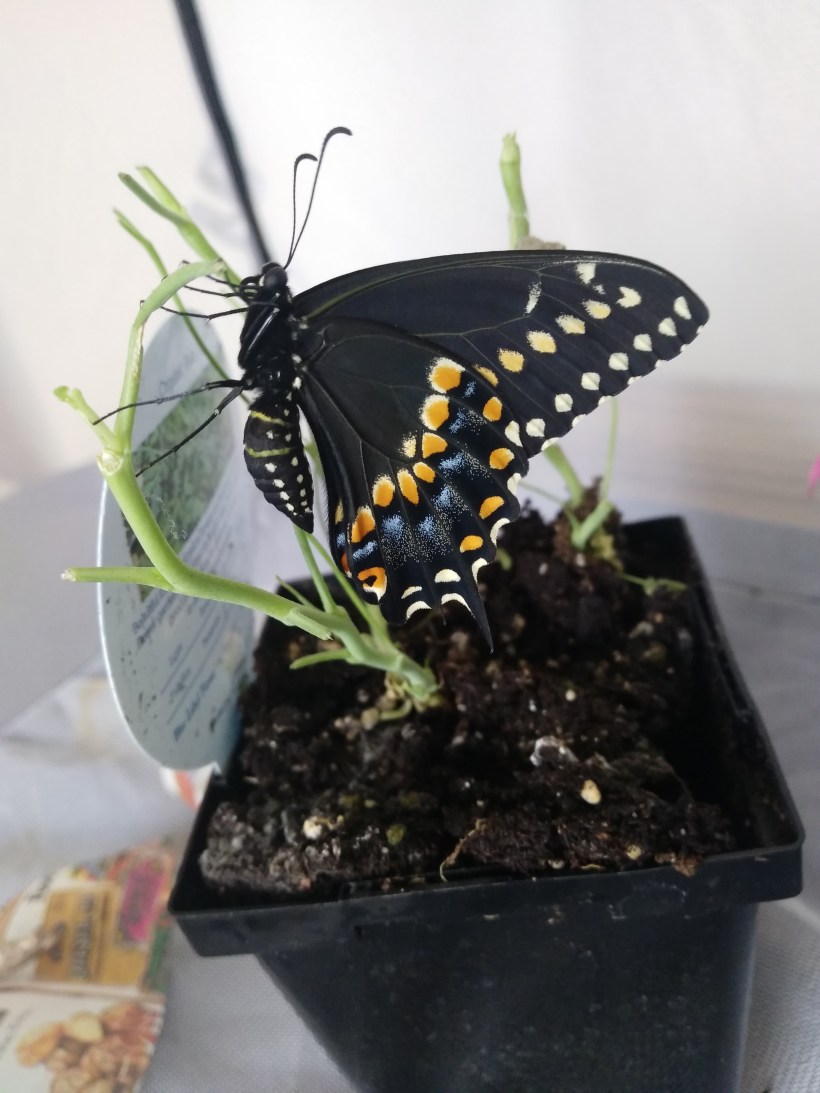
We have a black swallowtail caterpillar. I found it in our rue plant. It was already fairly big, and it is forming it’s chrysalis as I write this post. I have raised dozens of these little caterpillars which are extremely common in our area. I’m quite familiar with their life cycle now. In a couple of weeks, our lowly caterpillar will emerge as a new creature. Its life as a caterpillar will be over and its life as a butterfly will begin. Everything in this world is a cycle of death and new life.

Black Swallowtail caterpillars we raised a couple of years ago.

Today I sat with my boys and watched a series of videos of the last week of the Savior’s life, the last supper, the suffering in the garden, the betrayal, the trial, and the execution of our Lord. I thought of how disturbing the scene was; the Son of God in all his purity and goodness, judged and condemned by people consumed with the devil’s bile, then not only murdered, but tortured, humiliated, and defiled. How could I watch this scene play out? How could I stand to witness such evil? Because I know from many repetitions what the end of the story will bring; a glorious triumph and resurrection. My faith in the resurrection is the only thing that makes the story of the death of the Savior bearable.

I’ve read the summaries of the Mueller report. I haven’t read the entire thing. I’ve spent several days pondering on, not only the report’s conclusions, but on the reactions of others to the report. The report itself doesn’t tell us anything we shouldn’t already know. We have an amoral man as our President, a man who knows no boundaries besides force, a man who cannot be trusted with power. We knew these things, or should have known them, long ago. And yet, there is no consensus of the majority to impeach him. We are on the precipice of history and everything hangs on our willingness to stand against corruption and hold the powerful to account, but we haven’t the conviction to do it.

Our national will is soft, our convictions like clay. We are tired of leading the world. We have taken the gifts of our Lord and they have made us fat and lazy so that we are no longer worthy of them. We condemn the innocent and exalt the guilty. We call good evil and evil good. How can His hand remain with us? How can He continue to pour out his blessings upon us in our sin? He can’t, and he won’t.

Consider the division that existed at the time of the Master. He enters the city of Jerusalem to Messianic shouts, palm fronds, and children proclaiming that he is the Son of God. There are masses of people praising him and celebrating the fulfillment of Messianic prophecies. Then days later he is taken before the people who then cry “Crucify Him!” How can this be? How can one city have two such extreme views of the same man? I never understood it until Donald Trump was elected. We are them. Half of the country is saying he is God’s chosen leader, and the other half is saying he is unworthy to remain in office. Which is it? Who can discern? Not enough of us, I fear.

And so our nation will perish, like the caterpillar whose insides melt within the chrysalis. We will enter a season of change so dramatic that I think we will emerge from it completely transformed. God created the caterpillar. He designed the transformation, every stage of the metamorphosis is known to him. I imagine that he knew at this nation’s founding that this would take place. The trouble is, I don’t know. I only see the decay and rot of our national character; the destruction of what was once bright and beautiful.

Black Swallowtail chrysalis

When the Savior was being crucified, I can’t imagine the terror and despair of his disciples, his family, and his friends. I shutter to think of how dark the world would seem after that great light was extinguished in such a barbaric and traumatic way. How could they have lived through the next three days with the memories of his final moments etched into their brains, replaying again and again?

And yet, God’s design was not complete. He knew what his disciples did not understand, that death would come before resurrection, that evil would triumph before righteousness would. There must be a death before there is a rebirth. Satan would not win the day, for the Master would take up his life again, and no man would have the power to take it from him again. In his resurrected form, he guides his followers as he spreads his gospel across the world today. There is no language, no nation, and no barriers that will keep the Master from finding and gathering his sheep. There will be a gathering.

As I watch this transformation happen, I keep my faith firmly planted in my Savior’s grace. I say with William Clayton who wrote Come, Come Ye Saints:


And should we die before our journey’s through,
Happy day! All is well!
We then are free from toil and sorrow, too;
With the just we shall dwell!
But if our lives are spared again
To see the Saints their rest obtain,
Oh, how we’ll make this chorus swell-
All is well! All is well!

I don’t know what exactly the future will bring with regards to my beloved country. I do know that troubled times are ahead. I know that the devil rages in the hearts of men, that truth is hard to find and harder to understand. I trust that no matter what this life will bring for me and my children, that we have trusted in Him who is Mighty to Save. He will not abandon us.

Black Swallowtail butterfly after emerging from his chrysalis.

Twitter Projections; Profile in Masculine Emotional Reactivity

I had a fascinating exchange on Twitter yesterday. It started out when “Marine Now” took issue with a friend named Melissa who posted angrily about how her taxes went up. She has to pay a tax bill this year and she is really upset about it. Marine Now, who I’ll call MN for the rest of this post, first questioned the Melissa’s reality and ability to comprehend her own taxes, then pivoted to her choice of her career. She was a “writer” which in his mind clearly showed that her problems with money were due to her “emotional” choice of career. He then posted patronizingly about people like her are always letting their emotions cause problems for them. She replied to him in good faith trying to draw him out. He expanded into a tirade against “Little Suzy” who becomes a social worker because she cares so much and then she can’t pay her student loans. He further revealed himself when he unexpectedly diverted into immigration. Of course, MN was extremely hostile to illegal immigrants. No surprises there, but the fact that he brought it up was particularly telling, as no one on the thread had said anything about immigration. For some reason, taxes, caring people, social workers, writers, and immigration were all connected in this person’s mind.

I engaged with MN for a while and he revealed a few more things about himself and his career in the Marines. His profile pic was stereotypically masculine with buzz cut hair. He liked to talk about how much money he makes and how much taxes he pays. I got the distinct impression he was exaggerating, and I told him as much. He also seemed very concerned that everyone agree that taxes went down and that the country is doing great. In my typically direct Twitter way, I called him on his psychological projection of emotional volatility, saying that it was he and not Melissa that was letting his emotions lead him into assumptions, unrelated issues, and personal attacks. I explained that he was failing to take a rational and dispassionate look at the evidence: Mellissa paid more in taxes this year. The GOP was and is saying there was a tax cut for middle class Americans. She is a middle class American and feels cheated. The fact that MN in fact paid less in taxes while earning more money overall doesn’t change that reality, but does bring more questions to mind about the overall fairness of the tax situation. He was uncomfortable that Melissa’s account was threatening his beliefs about the tax cuts. He needed to own his own feelings and then engage with the facts at hand.

NM was really angry at me by this point. Naturally. His emotional reactiveness in which he was in denial about was then projected onto me. I was now the personification of “Little Suzy” the knowledgable social worker who was married to his friend and likely tried to help him with his possible PTSD or other emotional health issues. Clearly, I was overcome with emotional nonsense and buried in debt. I was this hated individual who was responsible for all his pent up rage, and I am not really a person, just a profile picture, and so he could freely vent his rage at me. He was blocked of course, and I take good care to protect my identity on Twitter. Safety first! Besides, this type of person picks fights wherever he goes. I would be surprised if he hasn’t already made a dozen enemies since breakfast.

The internet is a fascinating place because people who ordinarily don’t engage with their emotions and never express them, seem able to do so from behind the computer screen. We tend to see this as a bad thing, but I’m not sure it is. After all, MN was angry before he engaged with Melissa and I, he just doesn’t understand how to deal with it. Almost certain that he probably hides behind his job and his military career, concealing his rage which he only vents to strangers online. We, not his friends, family, and co-workers see the real man. Whether this venting is actually helpful to him, I don’t know. I do know that talking about emotions is good.

Talking about emotions is terribly healthy. Even when they are only projections. It’s wonderful when we can own our emotions, understand them, and control and manage them in our relationships, but even when we can’t, even when we can only project them, it is better than keeping them inside. For example, I scream at my counselor, “You don’t understand me! You just think I’m crazy like everybody else does. Of course I can go join the circus and make a career as a trapeze artist!! It doesn’t matter that I am out of shape, I have neck problems, and I’m terrified of heights. You just think I’m crazy. I’m going to prove you wrong!” Then I think on what I have said and my counselor says quietly, “I don’t think you’re crazy. Why do YOU think I think you are?” Now we can get somewhere. Suddenly my zeal for the circus life is fading and I come to see the reality that I feel like everyone thinks I’m crazy and incapable of succeeding at my goals. My anger at this injustice is clouding my judgement and sabotaging my efforts. Now that I am self aware of my emotions, I stop projecting them and make more reasonable goals based on my real needs and not on the perception that I need to change other’s opinions of me with a rash career shift to the circus.

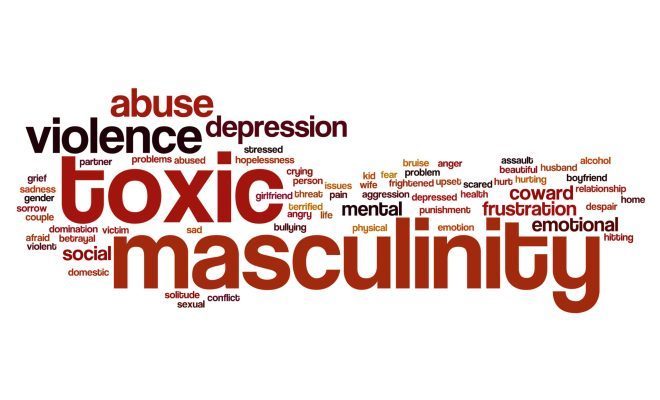
Instead, MN and others conditioned in toxic masculinity cannot own emotions, so they project emotion onto everyone else. If they don’t see emotionality in others, they will provoke it with insults or pestering. Once they get the emotional reaction they are looking for, they can then project their emotionality onto the other person and get a little bit of relief from the emotional pain they are in by blaming and shaming the other person, usually a woman, but sometimes a child or a less toxic man. I suspect this parasitic process underlies a lot of unhealthy relationships and will continue to do so until these men allow themselves to feel.

Toxic masculinity word cloud concept

I don’t imagine that my clinical approach to NM will result in his ownership of his own emotional demons. However, my refusal to allow him to provoke me into an emotional response was good. My ability to maintain a sense of compassion and understanding for him even in the face of his cruelty and bitterness shows that although I have my own emotional baggage I am carrying, I am still capable of love and patience with those who refuse to own theirs.

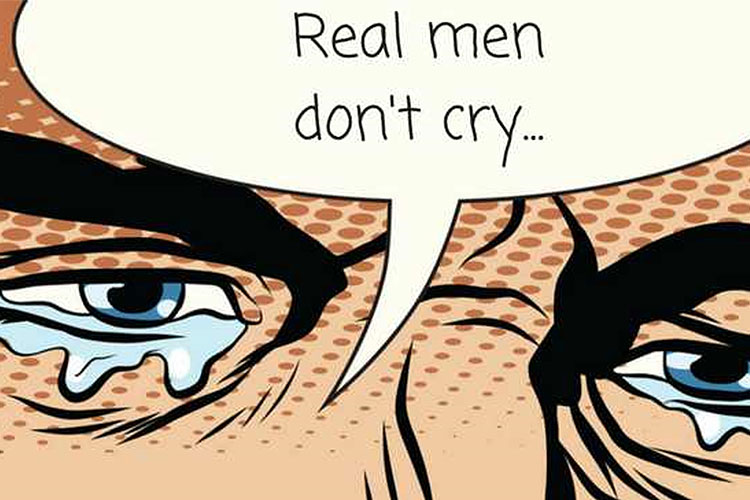
Speaking of emotional baggage and masculine issues, Austin again threw his crib across the room again last night. How does a three year old do that? At least he isn’t suppressing his emotions, right! I hope I can always teach my boys that real men don’t suppress or deny their emotions. Emotions are part of what make us human, and when we use them properly, they can magnify our minds, channel our efforts, and fuel our creativity. Compassion, empathy, understanding, and courage are all virtues that are made possible with understanding and applying the the principles of emotional health, and they were exemplified by the greatest man who ever lived, even Jesus Christ.

As Pilot said, “Behold the Man!” No man who ever lived had more mastery of his emotions than He. He was sensitive as a mother with a sucking child at her breast, and courageous as a soldier in battle in his clashes with Satan. He demonstrated the exalted form of masculinity that transcends the confines of this Telestial world. As we learn of him, as we study ourselves, as we seek to bring His divine form into our own hearts, minds, and bodies, we will become saints in deed. This is my prayer!

The BYU Honor Code; Do it Right

I read this article on the NPR website today about a protest of the honor code that took place today on BYU campus. The honor code is an integrity contract all students admitted to church schools sign agreeing to abide by a code of conduct. It is rigorous and every year students are expelled for failing to abide by it. My relationship with the honor code is complicated and this post explores some of my experiences and feelings about the issue.

First, the protest itself. Protests are not bad, and I think this one provides us an opportunity to have a conversation about the obvious concerns of the rising generation. This protest is completely in line with the trends we are seeing and have been seeing for almost fifty years. America has always been a land of rebels, but in the last fifty years, rebellion against norms has really taken off. Everything must be new and cutting edge, including our values. We cast off old values like we do the last decade’s fashions. In fairness, my move from a small town in rural Idaho, to a suburb of a major metropolis might skew my perspective some about how much has changed in society verses how much has changed around me. Even with that in mind, I think our norms are changing and changing fast, and for the rising generation, the traditional head down way of handling social issues just isn’t going to work.

Change is always hard, but change right now is inevitable. The Church of Jesus Christ of Latter-Day Saints is changing. I used to think that the true church of God would never change; that it would be a steady anchor in changing times, holding fast to steadfast principles. I still believe that to be true, but it is a little more complicated than I thought. The church is made up of imperfect and changing people living in a time of upheaval and flux. The principles remain the same, but the ways they are enforced; the policies and attitudes behind the principles must be flexible. Compassion and mercy must be balanced with principles when it comes to enforcement– But I passionately believe that if a standard is put in place, there must be enforcement. We can decide what that looks like in order to provide the best outcome for the students, but just putting the rules in place and expecting them to be followed, or putting students in charge of reporting on one another can be a disaster, as my story demonstrates.

I was a student at BYU in Provo for a short time twenty years ago. I lived at an apartment complex called Branbury Park. I had found it online on my dialup modem at home in Idaho. It looked fairly new and very nice. They had a great website. Their pictures marketed their BYU approved housing status and featured pictures that evoked thoughts of LDS culture. They were a little more expensive than most places, but I was planning to get a job and I thought it would be worth it to have my own room in a nice complex. I had just finished my Associates Degree at BYU-Idaho, and I thought BYU would be a great place to transfer that would have similar standards. BYU-Idaho, or Ricks college as it was back then, had strict enforcement of the honor code including curfews and boys not allowed in bedrooms. The complex appointed RAs, or Resident Assistants that were in charge of honor code enforcement. They had power and everyone knew it. We signed the honor code and we were expected to follow it. The day I moved into my new place at Branbury Park, I found an eerie note on my bed. It was a legal disclaimer stating that the BYU housing approval was not a guarantee that the BYU honor code would be enforced or even that the apartment was in compliance with legal safety standards. Clearly I wasn’t at Rick’s College anymore. It got worse from there.

I soon learned that Branbury Park had a notorious reputation on BYU campus as the party place. I had no friends and struggled badly with what I know now to be depression. I was stereotyped as a Molly Mormon and was treated as an outcast. My roommates would go clubbing at night in Salt Lake City. I invested in earplugs so that I could sleep though their endless parties. I learned very early on that the honor code was nothing but a formality to these BYU students. They thought nothing of going into their bishop interviews, promising to live by certain standards, and then breaking their word the same day. I remember me and my roommate had honor code appointments back to back. As soon as we got home, she was playing card games with some dude in her back bedroom. My other roommate was making out with her boyfriend on her bed. Thankfully, I had my own room.

They knew that I took the honor code seriously, but they also knew if I reported anything, they would know who the snitch was. They would make things miserable for me. They resented and feared me because of how I could mess up their lives, and I was terrified of them. I was stuck in a contract and I didn’t want any trouble.

One of our roommates moved out, but couldn’t get out of her contract, so she left her room empty. Another girl moved into her room without paying. She wasn’t a student at BYU or anywhere, and unlike the other kids at Branbury Park who liked to live a double life, she had no desire to look or act LDS. She had a terrible spirit about her. I remember the first time I saw her and her hatred of me seemed to radiate from her person. She terrified me. I still remember the dread I felt as I heard her move her things in. I thought the worst thing I had to endure that year would be when my FHE brother asked me to do a table dance and everyone laughed at me, or maybe when that nasty guy they called as the Gospel Doctrine teacher used the class as a recruitment tool for his network marketing business. This was the worst.

I agonized over what to do. Should I notify the apartment managers that a girl was living in our apartment that shouldn’t be there? Everyone would know who the snitch was. My life was bad enough in that apartment, but I felt like the line of decency had to be drawn somewhere. There were boys spending the night and beer parties in the parking lot. I came to BYU thinking that I would be with other kids who would be striving to live the honor code. As it was, I stood out dramatically for refusing to compromise myself. A couple of slices of bread were all that was needed for the entire ward for sacrament meeting. It made me wonder why these kids came to church at all. Why did they want to attend BYU? No one seemed to care about the gospel. I thought for sure I would find someone to be friends with, but I never did. If you were a decent person when you moved into Branbury Park, you weren’t by the time you left. Everyone on the outside judged me for living there. Everyone on the inside judged me for not being like them.

That was a dark time in my life. My sister was married to an abusive man. I was living far away from home for the first time. My tonsils were bad and I was almost constantly battling strep throat infections. I decided to quit going to school and got a job with the plan to move out as soon as possible. Even though I tried to sell my contract, I wasn’t able to. I stayed the whole year. I didn’t ever tell anyone about our squatter roommate. I had a feeling that she was better off in our apartment than wherever she was living before. At least she had a place to sleep.

Even though my roommates didn’t like me much, I stayed close to the Lord and I still loved them. Eventually I gave up trying to make friends in my ward and complex. I joined the UVSC institute and took as many classes as I could to avoid going home after work. I stashed bagels in my car so I wouldn’t have to eat at the apartment. I drove the five hours home almost every other weekend. When I did see my roommates I was cordial, but tried not to involve myself in their lives. The less I knew, the easier it was to live with the situation.

At one point my roommate Katy was not doing well. Her dad was a Dentist and she was rich and messy with lots of expensive clothes that she never took care of. Her room had so many clothes on the floor it was knee deep in some places. She was pretty and blonde and fairly nice. In another situation, we probably would have been good friends. If there had been more good influences around, she might have gone a different way. Unfortunately, she started hanging out with a nasty guy. She stopped sleeping at our apartment at night, and I was worried about her. I talked to my other roommates, and they were concerned about her too. Even by Branbury standards, she was slipping. She wasn’t going to class, and she had gotten into some substance abuse. I prayed about what to do. I told a member of the Bishopric that I was worried about Katy; that I didn’t want to get her in trouble, but that I thought someone should know what was going on. A few weeks later he told me that he had called her in to talk with him. She had started the repentance process and was doing much better. He wanted me to know. I had done the right thing. After he mentioned it, I could tell she was doing better. I don’t know what ever happened to Katy after I left, but I hope she was able to stay out of trouble. Maybe she moved out of that awful place. I hope so.

After that year, I was much more careful about choosing my apartments. I made certain that I never got into such a terrible mess again. I moved to a better place on BYU campus for the summer, and then started at Utah State the next fall. Part of the appeal of Utah State, was that there wasn’t an honor code. It wasn’t that I didn’t want to live the honor code. I have always been a straight arrow. I didn’t want to go to a church school where there was an honor code that wasn’t enforced. It put me in a difficult situation at Branbury Park and I never wanted to be in that place again. Better to have no standard, than a standard that isn’t enforced except for vague expectations about peer monitoring. It isn’t that I don’t like the idea of an honor code, it just needs to be done right and in practice, it isn’t always done right.

Here’s the thing. I know not everyone wants to live by the standard of the BYU honor code. That’s okay. There are lots of other schools people can go to. Anybody who gets accepted to BYU has plenty of options about where they want to go to school, so whining about the honor code rings hollow to me. There are lots of good kids willing to live the code that are turned away every year because they don’t qualify academically. They are taking you at your word that you have the moral qualifications to handle the honor code, but if you fail to live up to it, why should they be obligated to keep you? If you sign a contract saying that you are going to live by a code and then you don’t, you are only lying to yourself, the school, and God. You take a spot at a church school that someone else is more worthy than you to have. If you commit sin, God may forgive you, but that doesn’t mean that BYU has to keep you. If you violate the honor code, you are breaking your word to the school. Choices have consequences and that’s just life. If I choose not to go to work, I can’t go to church and repent and then expect that because God forgives me that I will still have a job. That’s not how it works.

That doesn’t mean I advocate that everyone who makes a mistake is kicked out. What I’m saying is, don’t conflate the forgiveness of God with the standards at BYU. They are two different things. If you want a good school with good academic standards, why is it different to want a school that also has high moral standards? What difference is there really between wanting people to understand and practice the rules of quadratic equations and wanting people to understand and practice the law of chastity? Yes, people will make mistakes, but should we just stop grading tests? Stop failing students? Tossing out the honor code would be the moral equivalent of throwing out the grade book academically.

A good school offers tutoring to those who struggle academically. I believe BYU should also provide support to those who struggle to live up to the standards of the honor code. If the code is wrong, that also needs to be addressed, but that isn’t what it seems to me that this protest was about. It is about mercy, forgiveness, and having a standard at all. In that, the core issue is the conflagration of divine forgiveness and the consequences of sin; the violation of divine covenants with the contracts of men. If I break the law, I have to pay a fine or do my time. That has nothing to do with whether God has forgiven me.

Of course, as a church and as a society at large, we are re-evaluating our sexual norms. The LGBT movement cannot be ignored. We must have faith that God understands what is beyond our knowledge and that as we extend mercy to those who struggle with these issues, and seek his wisdom, we will know the way forward. Sexual assault, or the situation in which I found myself with my roommates are not the fault of the students in impossible situations. We need to be careful in our judgement that we don’t condemn victims or give power to their abusers. No matter how careful we are, I still don’t see the future being warm and fuzzy when it comes to these issues. They are hairy and difficult for everyone. Still, we need to make sure that we aren’t neglecting our responsibilities when it comes to our own due diligence.

For example, if you are going to make money off kids paying rent at BYU and you market your complex as BYU approved housing, you should make sure that your rooms comply with legal safety standards and that the honor code is enforced. That disclaimer flyer may have protected Branbury Park legally, but God won’t forget the hell I went through that year. There are some people who profited from the mess that was allowed to happen at that complex. My mom and I were deceived and swindled and I’m guessing we weren’t the only ones.

My Branbury Park story is a cautionary tale. Don’t assume that when you send your kids off to a church school that all is well. There was a rumor that my family home evening brother was pimping out my roommates. I found it plausible. Seriously. Also, I’m all about compassion, forgiveness and second chances. I can see how the honor code might be a way to persecute and shun someone who is struggling to live a standard that is a little out of reach for them; but keep in mind that the opposite is also true, as my story shows. As our society re-examines shame and the enforcement of sexual values, we need to remember that if the standard is put up for our youth, it should be fairly and consistently enforced by the adults who preside over them. Not holding students accountable for keeping their promises rewards liars and punishes everyone else. If the standard isn’t enforced fairly and consistently, its better that it isn’t there at all.

Expecting young people to self monitor and report one another for honor code violations is unreasonable. I felt guilty at Branbury Park because I felt like I needed to tell someone about what was going on. I felt complicit because I was looking the other way and not reporting my roommates. Still, I knew that nothing I reported would have any effect. Obviously, the problems at that complex were much larger than I could do anything about. At one point I talked to one of the members of the bishopric hinting vaguely about how the honor code isn’t enforced like it was at Ricks. He seemed to know the burden I carried. He said, “This is a hard place for a girl like you to live.” He was right. I took his sympathetic response as permission to disregard the honor code violations of my roommates, but I never felt comfortable with it. I did the best I could, and looking back, I think I was a good example to my roommates, especially to Katy. I struck a good balance between compassion and obedience in a very difficult situation. Not everyone can do that, but I showed those kids that you could still live the honor code even at Branbury Park, even if it meant that you didn’t have a single friend for a whole year. Even if it meant eating bagels for dinner in your car every day.

I never wanted to be a hero or a Molly Mormon model of righteousness for a bunch of rebel kids. I just wanted to go to school and be accepted like everyone else; maybe go on a few dates. The Lord had other plans for me that year. Still, I wouldn’t wish it on another twenty-year old girl. We can and should be better at our church schools. My oldest son wants to go to BYU. I’ve never told him my horror story. I like that he has a BYU placard hanging in his room and wears BYU socks. In our world of shifting values, I hope BYU can make the honor code work. Clear and unchanging principles are rare and vanishing on our college campuses, and they are needed more than ever IMHO. Even though I never graduated from BYU, I can respect what they are trying to do-I just want them to do it right.